Efron's Dice
Statistics & Probability
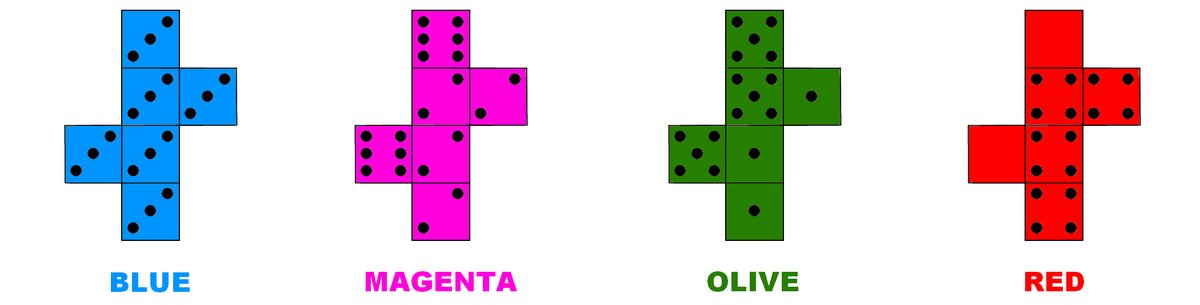
The idea for non-transitive dice has been around since the early 1970s
Where this idea comes from
Start here — this is the source that inspired this exploration.
Introduction
Efron's dice are a set of four dice, each carrying different numbers, that beat each other in a cycle: die A beats die B more often than not, B beats C, C beats D, and D beats A. Whichever die you pick, another die in the set beats it more often than not. The American statistician Brad Efron built this specific set to show that ‘beats’ does not have to behave like an ordinary ranking, even for something as simple as four dice.
Guiding Questions
- Efron's dice beat each other in a cycle, like rock-paper-scissors. Compute the winning probabilities for each pair.
- Why does 'A beats B' fail to be transitive here? Explain where the intuition breaks.
- Design your own set of non-transitive dice with a different cycle length.
- If your opponent picks first and you choose second, what is your best strategy and edge?