Sicherman Dice
Statistics & Probability
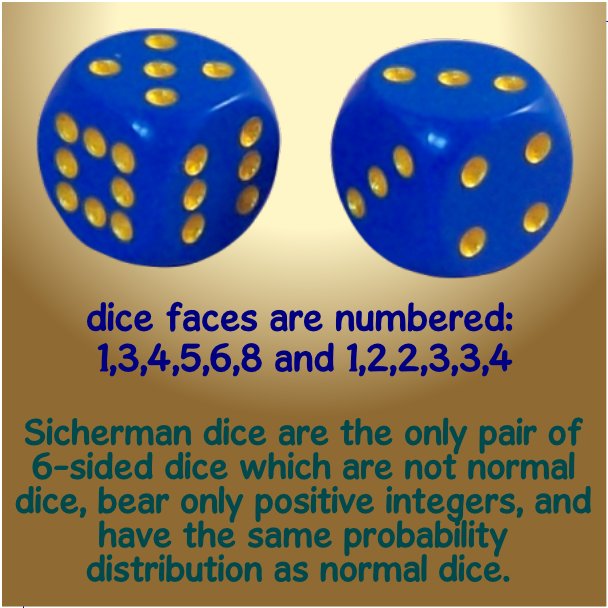
Sicherman dice, invented by Colonel George Sicherman in 1978, are a non-standard pair of 6-sided dice numbered 1, 3, 4, 5, 6, 8 and 1, 2, 2, 3, 3, 4. Despite the different numbering, they produce exactly the same probability distribution of sums as an ordinary pair of dice.
Introduction
An ordinary pair of six-sided dice gives sums from 2 to 12 with a well known triangular distribution, most likely a 7. Sicherman dice use entirely different numbers, yet produce that same distribution. This exploration checks the claim by listing outcomes, then explains why it works using generating polynomials (multiplying out the bracket that represents each die's faces), and asks whether any other such pair could exist.
Guiding Questions
- Roll two ordinary dice many times and record the sums. What distribution do you expect and get?
- Sicherman dice have different faces but the same sum distribution. Verify this by listing outcomes.
- Why does the trick work? Investigate with generating polynomials (multiplying out brackets).
- Sicherman dice are the unique alternative pair of standard 6-sided dice (positive integers only, six faces each) with the same sum distribution as ordinary dice. Restricting your search to that same family of dice, use the generating-polynomial argument to show why no third such pair exists.