Lagrange Points
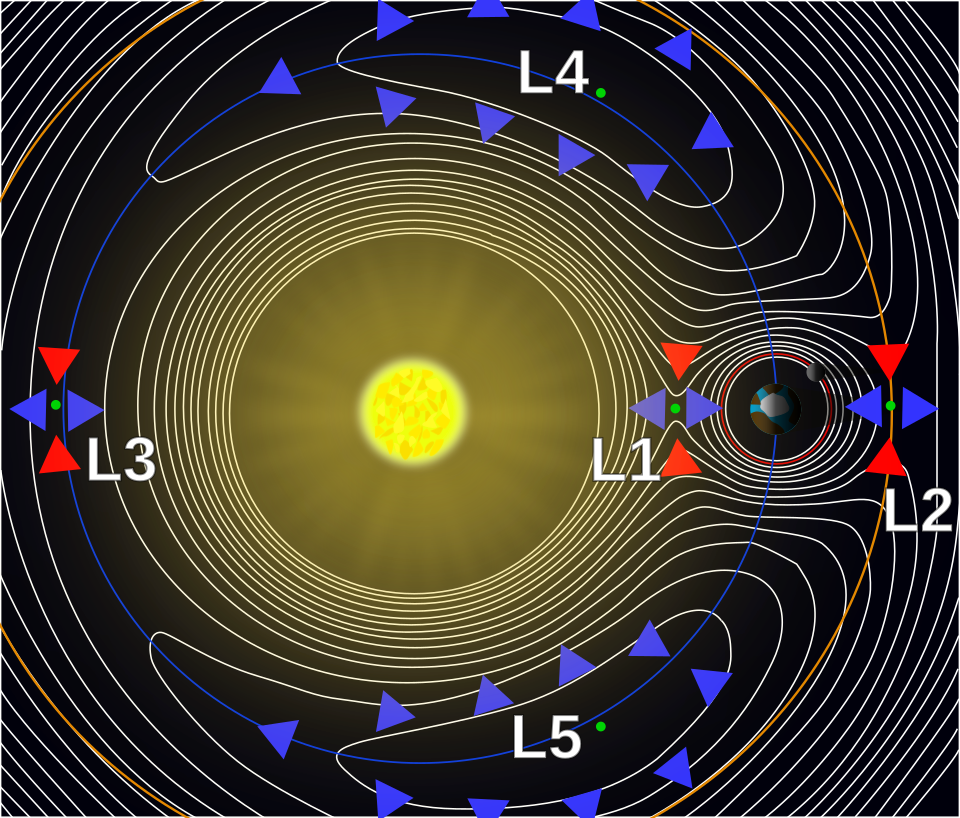
Model the point between Earth and the Sun where gravitational pulls balance, and see why a second, more useful balance point needs more advanced physics.
Where this idea comes from
Start here — this is the source that inspired this exploration.
Introduction
Explore a simplified, non-rotating model of the Lagrange points using vectors and the balance of gravitational forces. This approach correctly locates the L1 point between two bodies, such as the Earth and Sun. The L2 point, where satellites like the James Webb Space Telescope sit, requires a rotating reference frame and centripetal-force terms that go beyond standard DP mechanics, so treat L2 qualitatively rather than deriving it. Writing the forces as vectors draws on AI HL content; at SL, work directly with the force magnitudes along the Earth-Sun line instead.
Guiding Questions
- At a Lagrange point the pulls of two bodies balance. How do you write the gravitational forces as vectors?
- For the Earth-Sun system, set up the equation for the point between them where the pulls balance, and solve it numerically. This is the L1 point.
- James Webb sits near a different balance point, L2, on the far side of Earth from the Sun. This point needs a rotating (orbiting) frame of reference to explain, which goes beyond the static balance you modelled for L1. Describe qualitatively why a rotating frame changes the force balance, without deriving the full equations.
- Could you model how far a satellite can drift from the L1 balance point before the forces pull it away?