The Humber Bridge's Towers Are 36mm Further Apart at the Top — Can You Prove It?
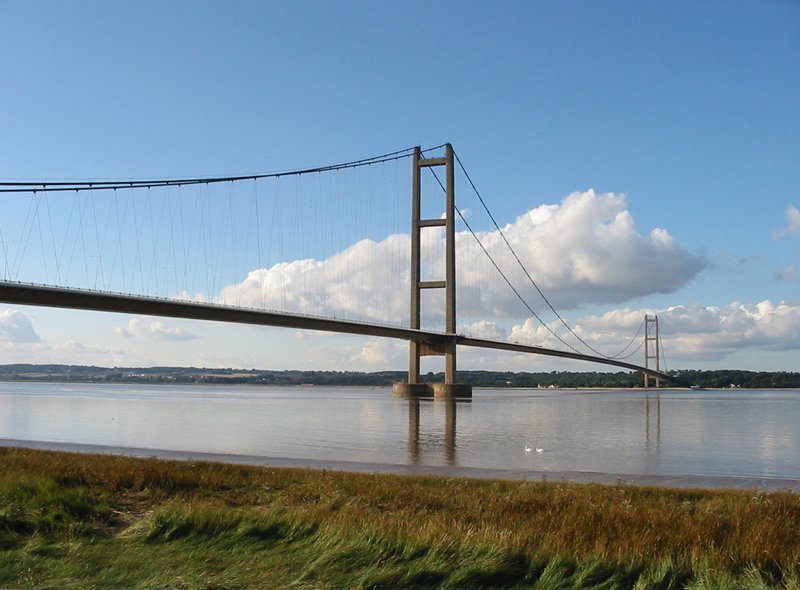
Both towers of the Humber Bridge were built perfectly vertical — and because the Earth curves, that means they are not quite parallel to each other. Work out how much wider apart the tops are than the bases, and check it against the number engineers actually used.
Where this idea comes from
Start here — these are the sources that inspired this exploration.
Introduction
The Humber Bridge crosses the Humber Estuary in England, between Barton-upon-Humber and Hessle, near Kingston upon Hull. Its two towers stand 1,410 m apart at the base and are 155.5 m tall. Both were built vertical — each one points toward the centre of the Earth, the way a plumb line always does. On a flat Earth that would make them parallel. On a curved one it does not: two "vertical" lines through different points on a sphere only meet at the planet's centre, so they spread apart the higher you go. Engineers accounted for this, and the figure usually quoted is that the tops of the towers are 36 mm further apart than the bases. This exploration is about deriving that number yourself from the bridge's real dimensions, rather than taking it on trust.
Guiding Questions
- The angle between the two towers, measured from the centre of the Earth, is the base separation divided by the Earth's radius — this is exactly what radian measure means, applied to a very large circle. Calculate that angle for the Humber Bridge.
- Using that angle and the tower height, estimate the extra separation at the top with a small-angle approximation, treating the two towers as the long sides of a thin triangle.
- How close does your answer come to the widely quoted 36 mm? Redo the calculation with exact trigonometry instead of the small-angle approximation — does it change your answer meaningfully at this scale?
- This effect only shows up because both towers are built plumb (vertical), not parallel to each other. Find out why engineers build tall structures plumb rather than parallel, and what would go wrong on a bridge this size if they had been built parallel instead.
- Repeat the calculation for a taller or wider suspension bridge, such as the Akashi Kaikyō Bridge in Japan. Does the effect get bigger or smaller, and why?