Why Does the Piston Pause at the Top?
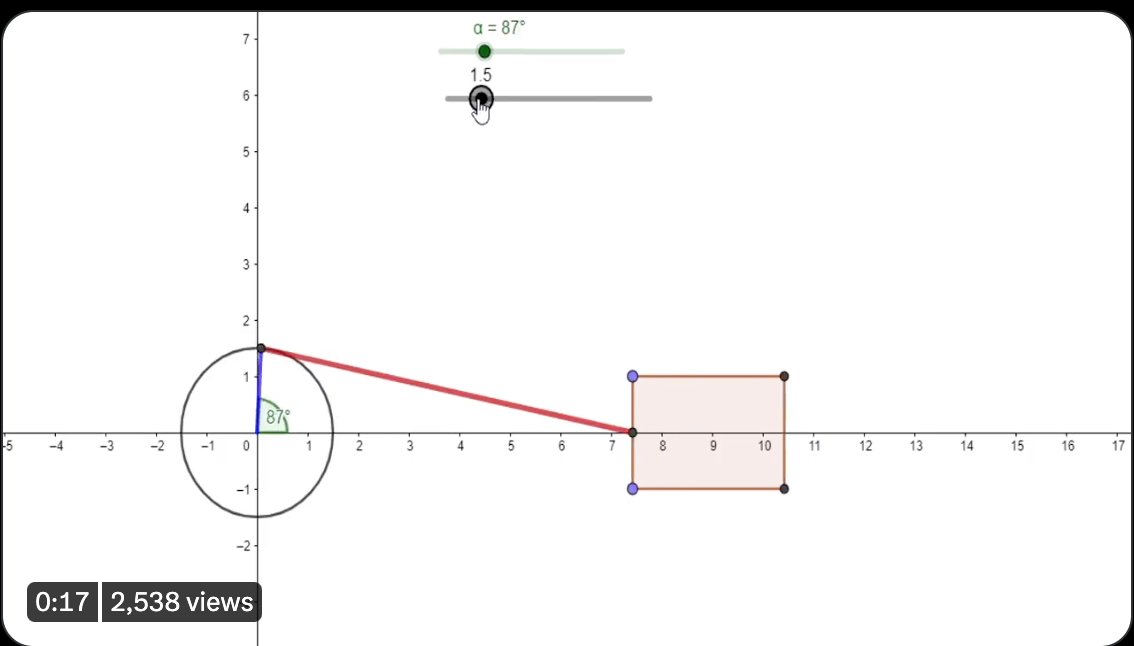
As a wheel rotates at constant speed, a connected piston moves back and forth in a straight line, slowing to a stop at each end of its stroke. Model the piston's position as a function of the wheel's rotation angle to see why.
Where this idea comes from
Start here — this is the source that inspired this exploration.
Introduction
A wheel-and-crank mechanism converts circular motion into straight-line motion: as the wheel turns at a constant angular speed, a rod connected to a point on its rim pushes a piston back and forth in a straight line. Even though the wheel spins at constant speed, the piston does not move at constant speed — it pauses briefly at each end of its stroke and moves fastest in the middle. This exploration models the piston's position as a function of the wheel's rotation angle, and uses the derivative to find where the piston moves fastest and where it momentarily stops.
Guiding Questions
- As the wheel turns at a constant angular speed, how does the piston's position change over one full rotation?
- Express the piston's position as a function of the wheel's rotation angle. What family of functions describes this motion?
- Where is the piston moving fastest, and where does it momentarily stop? Use the derivative to find these points.
- Design a mechanism with a different motion profile of your choice — for example, twice the pause time at each end, or an uneven stroke length.