Bezier Curves and Design/Typography
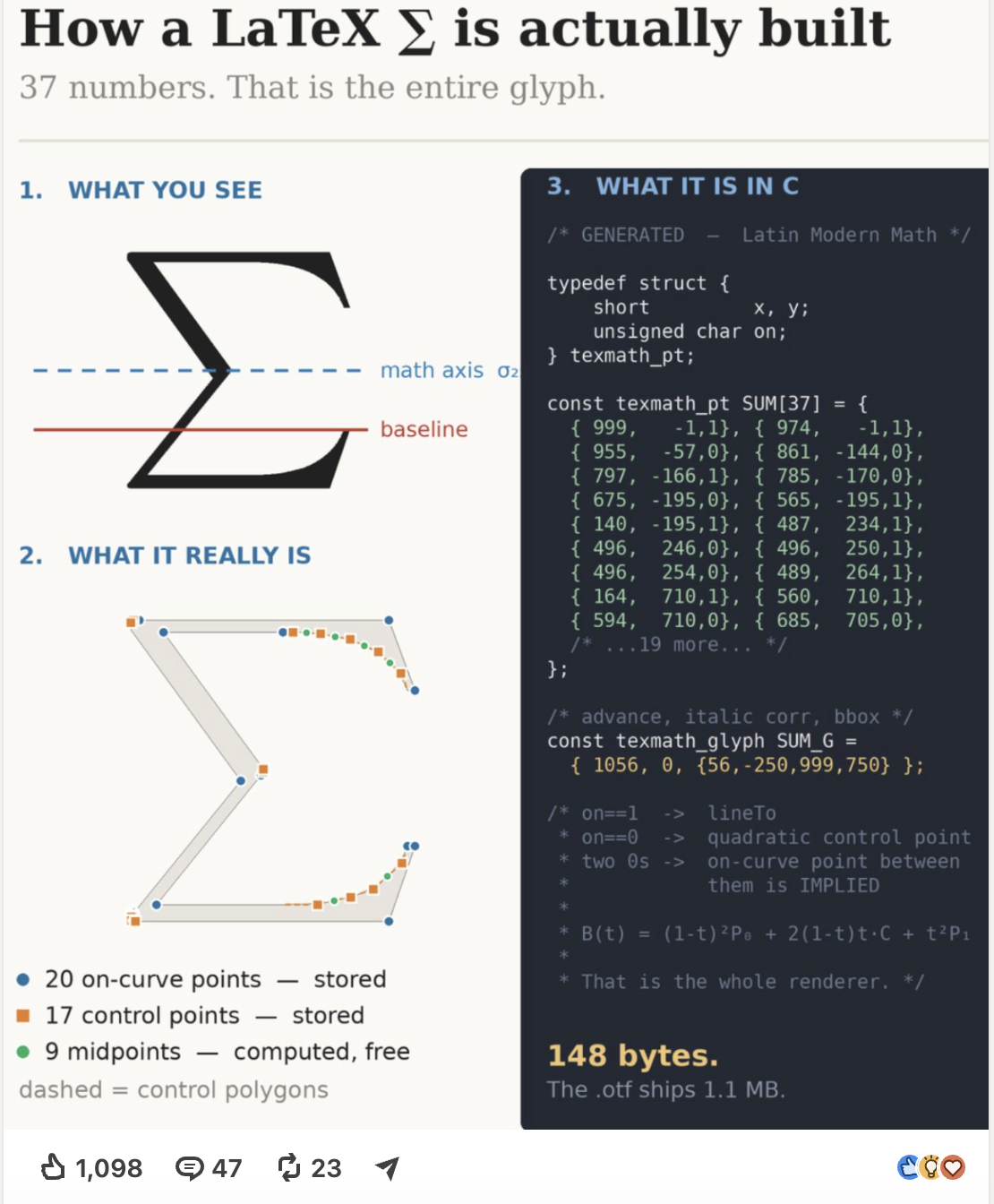
The letters on this screen are built from a handful of curves called Bezier curves — the same maths font designers use to draw every character.
Where this idea comes from
Start here — these are the sources that inspired this exploration.
Introduction
Every letterform in a digital font is built from a small number of curves called Bezier curves, defined by a handful of control points rather than a long list of coordinates. A quadratic Bezier uses three control points; a cubic Bezier, used in most font and vector-graphics software, uses four. Moving one control point reshapes the whole curve in a predictable way, which is what lets a font designer bend a stroke smoothly with a mouse instead of plotting hundreds of individual points. Open a letter in a font editor, or trace one in Inkscape or Illustrator, and you'll see exactly these control points sitting behind the curve you're used to reading.
Guiding Questions
- A quadratic Bezier curve is built from three points: B(t) = (1-t)²P₀ + 2(1-t)t·C + t²P₁. Plot your own three points and trace where the curve goes as t runs from 0 to 1.
- Differentiate B(t). What does the tangent direction at t=0 tell you about the control point C?
- How do two Bezier curves join smoothly? What condition on control points makes the join invisible?
- Recreate a letter or logo using a handful of Bezier curves. How few can you get away with?