Monopoly Is Rigged (and You Can Prove It)
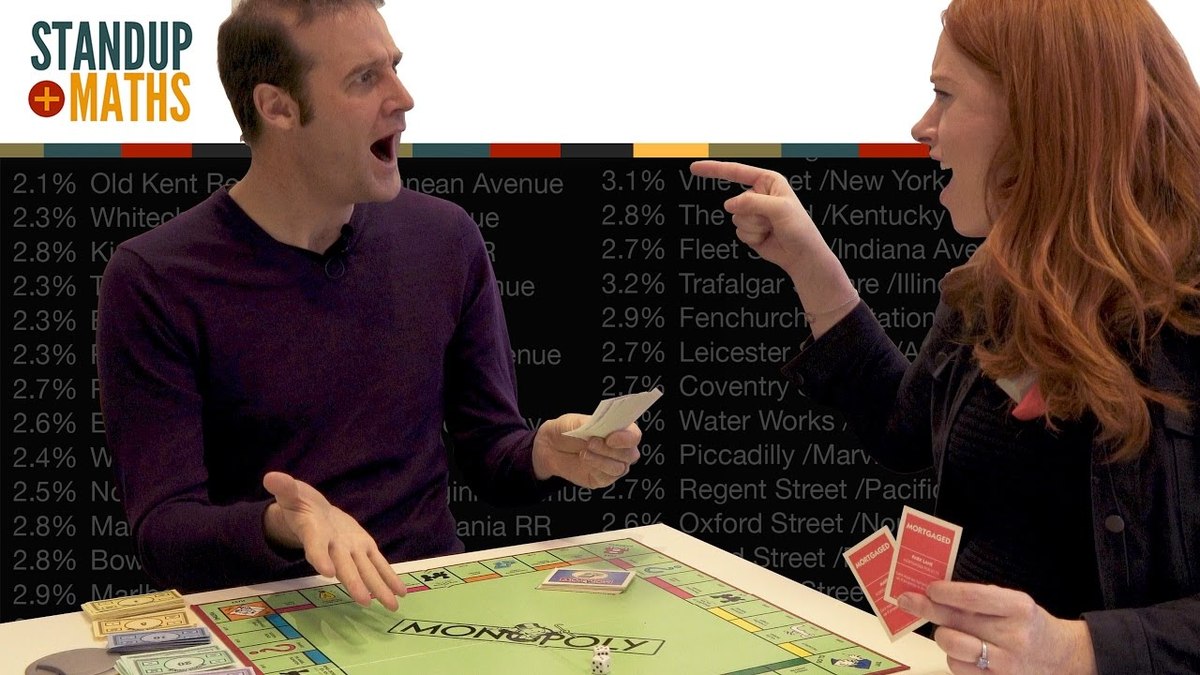
Some Monopoly squares get landed on far more than others — it's why the orange set wins games. Work out where the dice send you from each square, follow the chains, and find the squares the game secretly favours.
Where this idea comes from
Start here — these are the sources that inspired this exploration.
Introduction
Every turn in Monopoly is the same experiment: from where you stand, two dice decide where you go next. That means you can write down, for any square, the chance of reaching every other square — and once you have that table, you can follow it forwards: two turns, ten turns, a whole game. The landing chances stop changing after a while, and they are not equal — Jail and the squares six to nine spaces after it do suspiciously well. Matt Parker and Hannah Fry raced each other to crack this; watch them after you've made your own predictions. The transition-matrix method used here is AI HL content (topic 4.19); at SL, question 3's spreadsheet approach still works as a simulation, just without the formal matrix-power machinery.
Guiding Questions
- Before any maths: which three squares do you think get landed on most? Write your guesses down.
- Two dice don't make every distance equally likely. Work out the chance of moving each possible distance, then the chance of reaching each square from GO in one turn.
- Set the table up in a spreadsheet so you can apply it repeatedly. What do the landing chances settle towards after many turns — and do they depend on where you started?
- Your model so far ignores some of the real rules. Pick one rule you left out, build it in, and find out which squares it favours.
- Turn your findings into advice: which property set has the best ratio of landing chance to price? Would a tiny rule change overturn it?