Stuck at Deuce
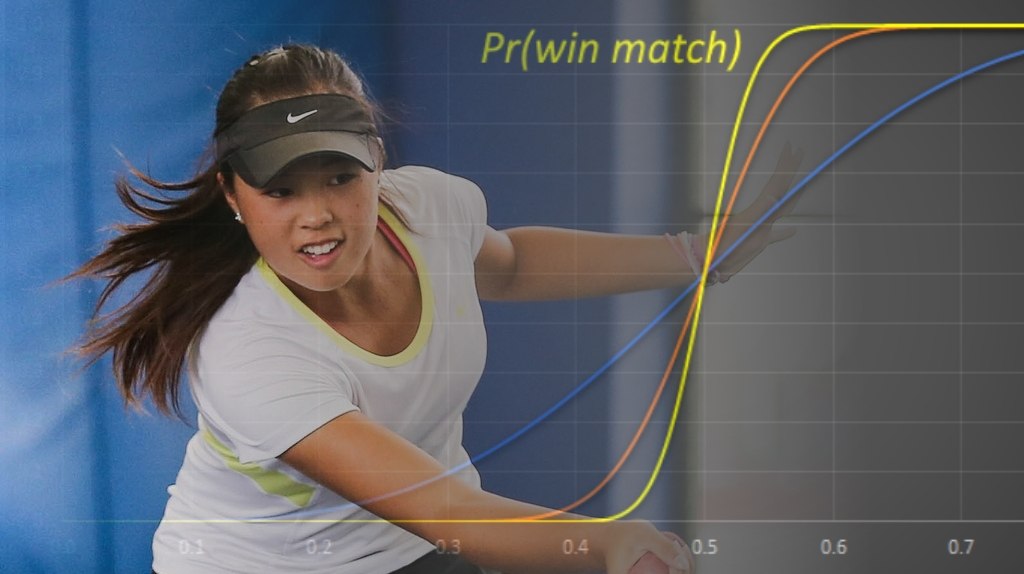
You win 60% of points on your serve — so how often do you win a game that reaches deuce? It isn't 60%, and you can find the real answer by tracking just three situations.
Where this idea comes from
Start here — these are the sources that inspired this exploration.
Introduction
From deuce, a tennis game has only three states that matter: deuce, advantage you, advantage them. Each point moves you between them. That small map is enough to answer the question exactly — and the answer surprises most people: a small edge per point becomes a much bigger edge per game. The same idea runs table tennis at 10-10, volleyball at 24-24 and penalty shootouts, so you can take this anywhere you actually play. Solving the three-state system formally as a transition matrix is AI HL content (topic 4.19); at SL, the same three balance equations can be solved directly as simultaneous equations without the matrix machinery.
Guiding Questions
- Play it first: flip a weighted spinner or use a random number to simulate deuce battles where you win each point 60% of the time. What fraction of games did you actually win?
- Draw the three situations and the arrows between them, with a probability on each arrow. Use the diagram to write an equation for the chance of winning from deuce, and solve it.
- Your whole model rests on a single number — the chance of winning one point. Investigate how the deuce advantage behaves across its full range. Where does being slightly better matter most?
- Real serving isn't constant: pressure, first vs second serve, momentum. Choose one way reality differs from your model, build it in, and see whether the conclusion survives.
- Take it to a sport you play: collect real point data and decide how big your 'deuce advantage' actually is.