The Secretary Problem: When Should You Stop Looking?
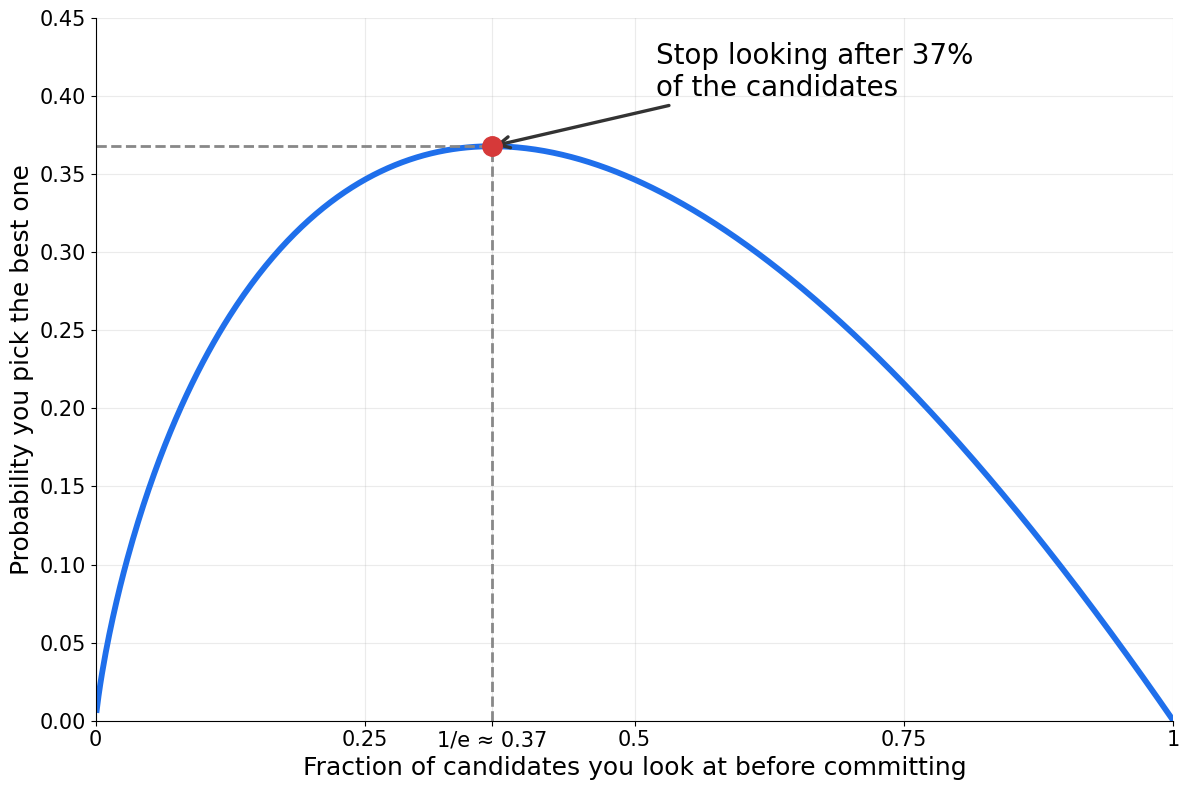
You interview candidates one at a time and must hire or reject each one on the spot — no going back. When should you stop looking and commit? A famous probability problem with a surprising answer: 37%.
Where this idea comes from
Start here — this is the source that inspired this exploration.
Introduction
Imagine choosing a flat, a parking space or a hire — you see options one at a time, and once you pass on one, it's gone. The best known strategy is to look at the first 37% of options without committing, then take the next one that beats everything you've seen. That 37% is no accident: it is 1/e, and the strategy succeeds about 37% of the time, far better than guessing. This exploration mixes probability, simulation and a little calculus, and you can test the whole thing with a shuffled deck of numbered cards. The final calculus step, differentiating x ln x with the product rule to find the maximum, is AI HL content; AI SL students can find the optimal fraction by graphing the success probability against x = k/n and reading off the maximum instead.
Guiding Questions
- Play the game with shuffled numbered cards: turn them over one at a time and try to stop on the highest card. What strategy did you find yourself using?
- For the strategy 'look at the first k, then take the next best-so-far', work out the probability of success for small n (say 3 or 4 candidates) by listing every ordering.
- Simulate the strategy for larger n on a spreadsheet. What fraction k/n gives the best success rate, and what number does it approach as n grows?
- Why does e appear? Investigate P = -x ln(x) where x = k/n, and use calculus to show the maximum is at x = 1/e.