Why Your Car Doesn't Skid on a Turn
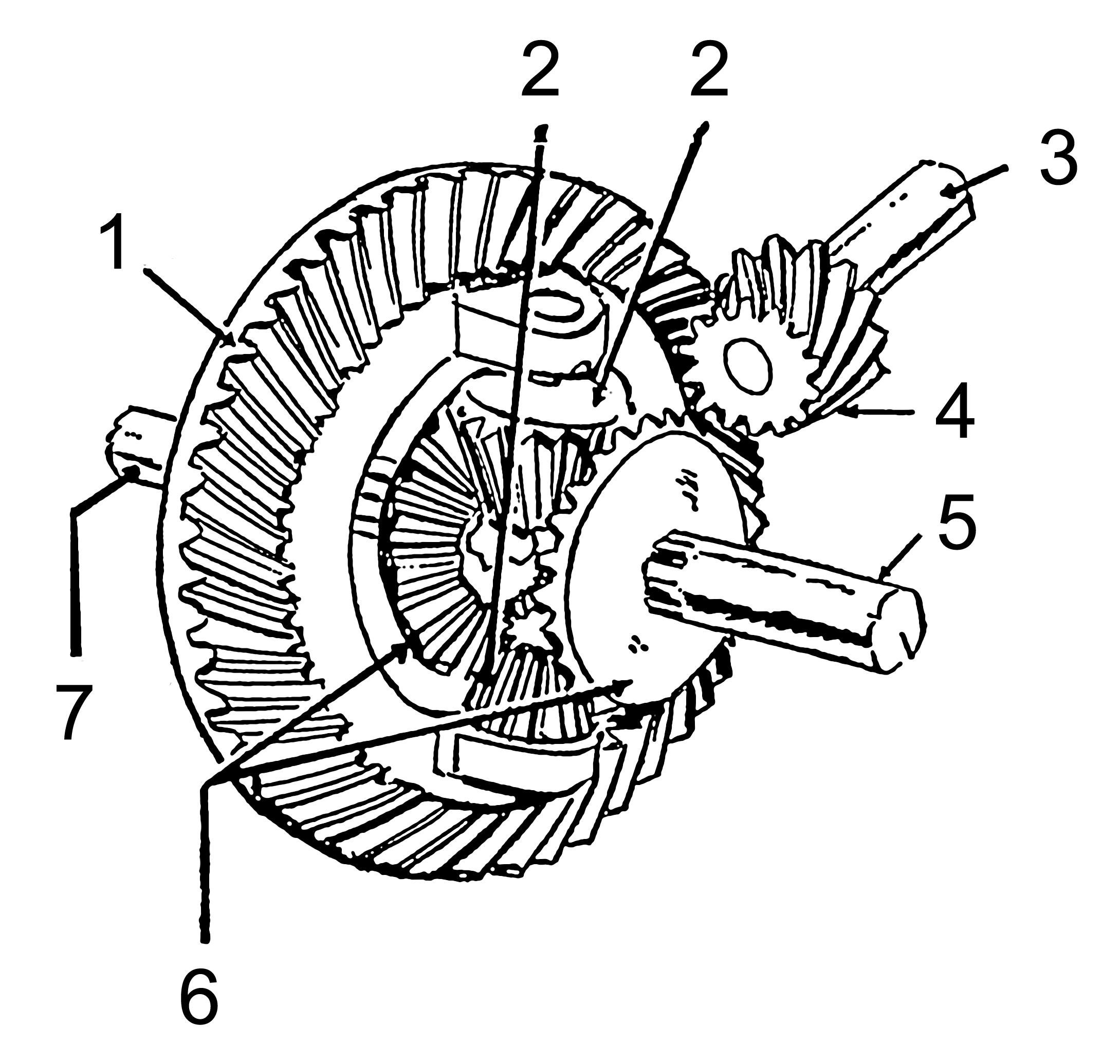
On every corner, your car's inside and outside wheels travel different-sized circles — so they can't both be spinning at the same speed. What stops them scuffing?
Where this idea comes from
Start here — these are the sources that inspired this exploration.
Introduction
When a car turns a corner of radius R with track width w, the inner wheel follows a circle of radius R − w/2 and the outer wheel follows R + w/2 — both sweeping the same angle in the same time. That forces a fixed speed ratio between them, (R + w/2)/(R − w/2), which grows sharply as the turn gets tighter. A rigid axle can't do this: it forces both wheels to spin at the same rate, so on every turn at least one wheel must slip against the road. The differential is the mechanism that solves this — and it comes with a genuine catch of its own once you ask what happens when one wheel loses grip entirely.
Guiding Questions
- How do you derive the speed ratio between the inside and outside wheel in terms of turn radius and track width?
- What happens to that ratio as the turn radius shrinks towards the track width?
- Why does a rigid (non-differential) axle force one wheel to scuff against the road?
- Each wheel travels an arc length equal to its radius times the turn angle. Use this to write the angular velocity of each wheel in terms of the car's forward speed, R and w. Do the wheels turn at different angular velocities, different linear speeds, or both?
- Write the speed ratio (R + w/2)/(R − w/2) as a rational function of R for a fixed track width w. Where is its vertical asymptote, and what does that asymptote mean physically for how tight a turn a rigid axle could ever manage?