Menu
Sign up Sign in

AI HL Β· 12.2

Finance

12.2.1

Finance Solver: compound interest and depreciation

12.2.1

Finance Solver: compound interest and depreciation

Target: Use the Finance Solver: N, I(%), PV, Pmt, FV, PpY, CpY; money handed over is negative (+3 more)

By the end of this section

TI-Nspire Finance Solver. Money you hand over is negative. Money you get back is positive. N = number of years Γ— periods per year.

Key points

The seven boxes

  • N: the number of periods. I(%): the annual rate, as a percentage. PV: the money at the start. Pmt: a regular payment. FV: the money at the end. PpY and CpY: payments and compoundings per year.
  • Fill in every box you know, put the cursor on the one you want, and press enter.
  • Money you hand over is negative. Money you get back is positive.

N and the rate

  • N = number of years Γ— periods per year. If the question already counts in months or quarters, that count is N.
  • I(%) is always the annual rate. The solver shares it between the periods.

Depreciation and inflation

  • Losing value is a negative I(%).
  • In real terms: \(r = c - i\), the change less the inflation rate. Use \(r\) as I(%).

On the calculator

Finance Solver

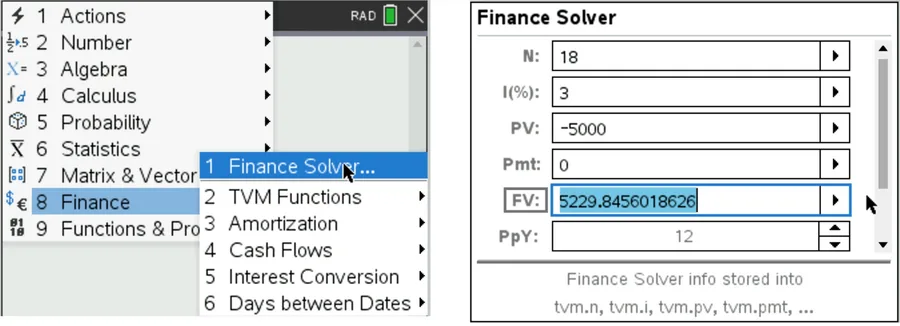
Menu > Finance > Finance Solver…

  • Tab moves between the boxes. Enter on the box you want solves it.
The Finance menu with Finance Solver picked out, and the solver showing N 18, I 3, PV βˆ’5000, Pmt 0 and FV 5229.85.

Explore: how often is interest added?

The same money at the same annual rate, compounded yearly, quarterly, monthly and daily. Put one column into your Finance Solver and find FV, then press Show FV to check.

The Finance Solver, one column for each way of compounding
BoxYearlyQuarterlyMonthlyDaily

Move a slider to compare the four.

  1. Which boxes of the Finance Solver change from column to column? Which stay the same? Why does N change?
  2. Before you press Show FV: which column gives the most money? About how much more than yearly?
  3. Set the rate to 15% and the years to 40. Is daily compounding much better than monthly? What about monthly against yearly?
  4. Why is PV negative and FV positive in the solver?

Worked examples

Problems like the ones in class. Pick one, try it, then open the working.
AI SL Finance and approximation slides Β· L02
What changes for depreciation?

A motorbike costs Β£14 500 and loses 18% of its value each year. Find its value after 4 years.

N4I(%)βˆ’18PVβˆ’14 500Pmt0FV?PpY1CpY1
Working
  1. N

    N = 4

    Once a year for 4 years.

  2. I(%)

    I(%) = βˆ’18

    Losing 18% a year is interest of βˆ’18%.

  3. PV and Pmt

    PV = βˆ’14 500, Pmt = 0

    The money at the start, handed over, so negative. Nothing is paid in or out after that.

  4. Solve for FV

    PpY = CpY = 1 β†’ FV = 6555.77

    The motorbike is worth Β£6555.77.

Video walkthrough coming
When has it lost half its value?

A car is bought for Β£21 000. It loses 11% of its value each year. After how many complete years is it first worth less than half of its price?

N?I(%)βˆ’11PVβˆ’21 000Pmt0FV10 500PpY1CpY1
Working
  1. The boxes

    I(%) = βˆ’11, PV = βˆ’21 000, Pmt = 0, FV = 10 500, PpY = CpY = 1

    Depreciation is a negative I(%). Half of Β£21 000 is Β£10 500.

  2. Solve for N

    N = 5.95…

    The value passes Β£10 500 part-way through the 6th year.

  3. Check the years

    N = 5 β†’ FV = 11 726.52; N = 6 β†’ FV = 10 436.61

    Complete years: 6.

Video walkthrough coming
AI SL Finance and approximation slides Β· L02
What is N?

$6400 is invested at 2.7% per year, compounded monthly, for 4 years. What is N?

Working
  1. The rule

    N = number of years Γ— periods per year

    Monthly means 12 periods per year.

  2. N

    N = 4 Γ— 12 = 48

    48 months.

Video walkthrough coming
AI SL Finance and approximation slides Β· L02
N when the time is already in months

$3000 is invested at 3.5% per year, compounded monthly, and left for 18 months. What is N?

Working
  1. N

    N = 18

    If the question already counts in months or quarters, that count is N.

Video walkthrough coming
AI SL Finance and approximation slides Β· L02
I(%) is the annual rate

Β£1000 is invested at 6% per year, compounded monthly, for 2 years. Find its value.

N24I(%)6PVβˆ’1000Pmt0FV?PpY12CpY12
Working
  1. N

    N = 2 Γ— 12 = 24

    Monthly for 2 years.

  2. I(%)

    I(%) = 6

    Type the annual rate. The solver shares it between the months.

  3. PV, Pmt, PpY, CpY

    PV = βˆ’1000, Pmt = 0, PpY = CpY = 12

    Β£1000 handed over. No regular payment.

  4. Solve for FV

    FV = 1127.16

    The investment is worth Β£1127.16.

Video walkthrough coming
AI SL Finance and approximation slides Β· L02
How long until it doubles?

Β£1000 is invested at 4% per year, compounded quarterly. How long until it doubles?

N?I(%)4PVβˆ’1000Pmt0FV2000PpY4CpY4
Working
  1. Fill in the boxes

    I(%) = 4, PV = βˆ’1000, Pmt = 0, FV = 2000, PpY = CpY = 4

    Doubling means FV is 2000. Money in is negative, money back is positive.

  2. Solve for N

    N = 69.66…

    Interest is added at the end of a quarter, so it takes 70 quarters.

  3. Change to years

    70 Γ· 4 = 17.5 years

    N comes back in periods, not years.

Video walkthrough coming
AI SL Finance and approximation slides Β· L02
How much must be invested now?

How much must be invested now at 2.4% per year, compounded quarterly, to have €5000 in 5 years?

N20I(%)2.4PV?Pmt0FV5000PpY4CpY4
Working
  1. N

    N = 5 Γ— 4 = 20

    Quarterly for 5 years.

  2. The other boxes

    I(%) = 2.4, Pmt = 0, FV = 5000, PpY = CpY = 4

    €5000 is what you get back, so it is positive.

  3. Solve for PV

    PV = βˆ’4436.19

    The sign flips: money in is negative. Invest €4436.19.

Video walkthrough coming
AI SL Finance and approximation slides Β· L01
Annual or monthly compounding?

€2500 is invested at 4.8% per year. (a) Determine whether annual or monthly compounding gives the better return. (b) Find the difference between the two values after 8 years.

Working
  1. Monthly

    N = 96, I(%) = 4.8, PV = βˆ’2500, Pmt = 0, PpY = CpY = 12 β†’ FV = 3667.55

    8 years of months is 96 periods.

  2. Annual

    N = 8, I(%) = 4.8, PV = βˆ’2500, Pmt = 0, PpY = CpY = 1 β†’ FV = 3637.73

    Only N, PpY and CpY change.

  3. (a)

    €3667.55 against €3637.73

    Monthly compounding gives the better return.

  4. (b)

    €3667.55 βˆ’ €3637.73 = €29.82

    The difference after 8 years.

Video walkthrough coming
AI SL Finance and approximation slides Β· L02
A delivery van: value, time and real terms

A delivery van is bought for €42 000. Its value depreciates by 14% per year. (a) Find the value of the van after 6 years. (b) Find the number of complete years after which the van is first worth less than €15 000. (c) Inflation over the 6 years is 2.2% per year. Using r = c βˆ’ i, find the value of the van after 6 years in real terms.

N6I(%)βˆ’14PVβˆ’42 000Pmt0FV?PpY1CpY1
Working
  1. (a)

    N = 6, I(%) = βˆ’14, PV = βˆ’42 000, Pmt = 0, PpY = CpY = 1 β†’ FV = 16 991.82

    €16 991.82, which is €17 000 to 3 s.f.

  2. (b)

    I(%) = βˆ’14, PV = βˆ’42 000, FV = 15 000 β†’ N = 6.83…

    After 6 years it is still worth more than €15 000, so the answer is after 7 years.

  3. (c) The real rate

    r = c βˆ’ i = βˆ’14 βˆ’ 2.2 = βˆ’16.2

    The change is βˆ’14% and inflation is 2.2%.

  4. (c) The value

    I(%) = βˆ’16.2, N = 6 β†’ FV = 14 544.99

    €14 544.99 in real terms, which is €14 500 to 3 s.f.

Video walkthrough coming
Which offer is better?

Β£8000 is invested for 6 years. Bank A pays 3.9% per year, compounded monthly. Bank B pays 3.95% per year, compounded annually. (a) Which bank gives the greater value after 6 years? (b) Find the difference between the two values.

N72I(%)3.9PVβˆ’8 000Pmt0FV?PpY12CpY12
Working
  1. Bank A

    N = 72, I(%) = 3.9, PV = βˆ’8000, Pmt = 0, PpY = CpY = 12 β†’ FV = 10 105.32

    6 years of months is 72 periods.

  2. Bank B

    N = 6, I(%) = 3.95, PV = βˆ’8000, Pmt = 0, PpY = CpY = 1 β†’ FV = 10 093.39

    Only N, I(%), PpY and CpY change.

  3. (a)

    Β£10 105.32 against Β£10 093.39

    Bank A is better, although its rate is lower: interest is added more often.

  4. (b)

    Β£10 105.32 βˆ’ Β£10 093.39 = Β£11.93

    The difference after 6 years.

Video walkthrough coming
Interest earned

$7200 is invested at 3.9% per year, compounded monthly, for 5 years. Find the interest earned.

N60I(%)3.9PVβˆ’7200Pmt0FV?PpY12CpY12
Working
  1. N

    N = 5 Γ— 12 = 60

    Monthly for 5 years.

  2. The other boxes

    I(%) = 3.9, PV = βˆ’7200, Pmt = 0, PpY = CpY = 12

    $7200 is handed over, so PV is negative. No regular payment.

  3. Solve for FV

    FV = 8747.47

    The investment is worth $8747.47.

  4. Interest earned

    8747.47 βˆ’ 7200 = 1547.47

    What comes back, less what went in. $1547.47.

Video walkthrough coming
Find the interest rate

€9000 is invested in an account where interest is compounded half-yearly. After 6 years it is worth €11 400. Find the annual interest rate, to 3 significant figures.

N12I(%)?PVβˆ’9000Pmt0FV11 400PpY2CpY2
Working
  1. N

    N = 6 Γ— 2 = 12

    Half-yearly means 2 periods per year.

  2. PV and FV

    PV = βˆ’9000, FV = 11 400

    Money in is negative, money back is positive. If both have the same sign the solver shows an error.

  3. The other boxes

    Pmt = 0, PpY = CpY = 2

    No regular payment.

  4. Solve for I(%)

    I(%) = 3.9789…

    The annual rate is 3.98%. The solver always gives the rate per year.

Video walkthrough coming
Find the rate of depreciation

A tractor is bought for $68 000. Its value falls by the same percentage each year. After 5 years it is worth $31 500. Find the annual rate of depreciation, to 3 significant figures.

N5I(%)?PVβˆ’68 000Pmt0FV31 500PpY1CpY1
Working
  1. N

    N = 5

    Once a year for 5 years.

  2. PV and FV

    PV = βˆ’68 000, FV = 31 500

    The price is paid out, so PV is negative. The value at the end is positive.

  3. The other boxes

    Pmt = 0, PpY = CpY = 1

    Nothing is paid in or out in between.

  4. Solve for I(%)

    I(%) = βˆ’14.2646…

    A negative rate is depreciation. The tractor loses 14.3% of its value each year.

Video walkthrough coming
An investment in real terms

Β£12 000 is invested at 5.2% per year, compounded annually, for 8 years. Inflation over the 8 years is 2.4% per year. (a) Using r = c βˆ’ i, find the value of the investment after 8 years in real terms. (b) Find how much would have to be invested for the investment to be worth Β£20 000 in real terms after 8 years.

N8I(%)2.8PVβˆ’12 000Pmt0FV?PpY1CpY1
Working
  1. The real rate

    r = c βˆ’ i = 5.2 βˆ’ 2.4 = 2.8

    The interest rate less the inflation rate. Type 2.8 as I(%).

  2. (a)

    N = 8, I(%) = 2.8, PV = βˆ’12 000, Pmt = 0, PpY = CpY = 1 β†’ FV = 14 966.70

    Β£14 966.70 in real terms. The account will show Β£18 001.44, but that money buys less than it does today.

  3. (b)

    N = 8, I(%) = 2.8, Pmt = 0, FV = 20 000, PpY = CpY = 1 β†’ PV = βˆ’16 035.59

    Now the real value is known and the amount invested is the unknown. It is negative because it is paid in. Invest Β£16 035.59.

Video walkthrough coming
A price that rises with inflation

A laptop costs €900 today. Prices rise by 3.4% per year. Find the price of the same laptop in 5 years' time.

N5I(%)3.4PVβˆ’900Pmt0FV?PpY1CpY1
Working
  1. The boxes

    N = 5, I(%) = 3.4, PV = βˆ’900, Pmt = 0, FV = ?, PpY = CpY = 1

    Inflation works like interest: the price grows by 3.4% each year.

  2. Solve for FV

    FV = 1063.76

    The laptop costs €1063.76. The price has risen by €163.76.

Video walkthrough coming