Arithmetic sequence
- Each term is the one before plus the same number, the common difference \(d\).
- \(u_n = u_1 + (n-1)d\)
- From the 1st term to the \(n\)th there are \(n - 1\) steps, not \(n\).
AI HL · 12.1
0 of 120 skills done
Arithmetic Sequences
12.1.1
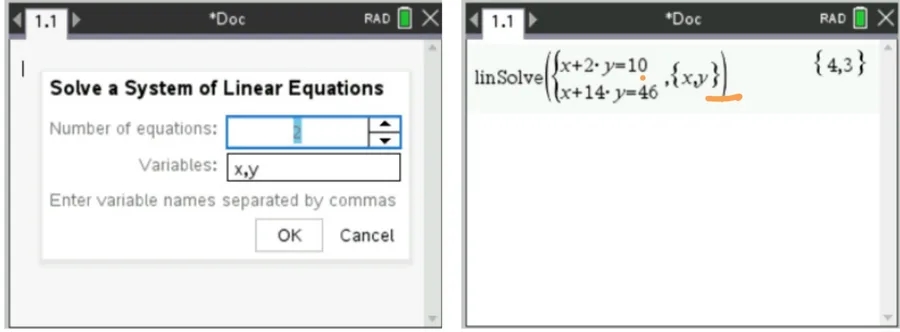
TI-Nspire: New Document (not Scratchpad). Menu > Algebra > Solve System… solves the two equations for the first term and the common difference.
New Document (not Scratchpad) · Menu > Algebra > Solve System…
nSolve(equation, n)
Screenshot and video to come
Choose arithmetic or geometric, then change the first term and d or r. Before you tick the box, predict what the sums Sₙ will look like.
| n | uₙ | Sₙ |
|---|
Move a slider to change the sequence.
An arithmetic sequence has first term \(u_1 = 7\) and common difference \(d = 4\). Find \(u_{20}\).
Have a go first. Then open the working one line at a time.
\(u_n = u_1 + (n-1)d\)
The first term, then \(n - 1\) steps of \(d\).
\(u_{20} = 7 + (20 - 1)(4) = 83\)
19 steps of 4 from 7.
An arithmetic sequence has \(u_1 = 12\) and \(d = 5\). Find \(u_{18}\).
Have a go first. Then open the working one line at a time.
\(u_{18} = 12 + (18 - 1)(5) = 97\)
17 steps of 5 from 12.
Find the 25th term of 40, 34, 28, 22, …
Have a go first. Then open the working one line at a time.
\(u_1 = 40\), \(d = 34 - 40 = -6\)
The terms go down by 6.
\(u_{25} = 40 + (25 - 1)(-6) = -104\)
24 steps of −6 from 40.
For the sequence 4, 11, 18, …, write an expression for \(u_n\).
Have a go first. Then open the working one line at a time.
\(u_1 = 4\), \(d = 7\)
The terms go up by 7.
\(u_n = 4 + (n - 1)(7) = 7n - 3\)
Check: \(n = 1\) gives 4.
Which term of the sequence 6, 13, 20, … is equal to 209?
Have a go first. Then open the working one line at a time.
\(u_n = 6 + (n - 1)(7)\)
\(u_1 = 6\), \(d = 7\).
\(6 + 7(n - 1) = 209\) gives \(n = 30\)
By hand, or with nSolve on the calculator. It is the 30th term.
Matchsticks are used to make a row of squares. One square uses 4 matchsticks, two squares use 7 and three squares use 10. (a) How many matchsticks make a row of 20 squares? (b) A row uses 154 matchsticks. How many squares are in it?
Have a go first. Then open the working one line at a time.
\(4,\ 7,\ 10,\ \ldots\)
The same amount, 3, is added each time: arithmetic with \(u_1 = 4\) and \(d = 3\).
\(u_n = 4 + (n - 1)(3) = 3n + 1\)
Check it on the first term: 3(1) + 1 = 4.
\(u_{20} = 3(20) + 1 = 61\)
61 matchsticks.
\(3n + 1 = 154 \Rightarrow n = 51\)
A row of 51 squares.
Is 149 a term of the sequence 9, 16, 23, …? Is 150 a term? If a number is a term, say which term it is.
Have a go first. Then open the working one line at a time.
\(u_n = 9 + (n - 1)(7) = 7n + 2\)
Here \(u_1 = 9\) and \(d = 7\).
\(7n + 2 = 149 \Rightarrow n = 21\)
A whole number, so 149 is the 21st term.
\(7n + 2 = 150 \Rightarrow n = 21.14\ldots\)
Not a whole number, so 150 is not a term. A term must have a whole-number position.
The third term of an arithmetic sequence is 10 and the 15th term is 46. Find the first term and the common difference.
Have a go first. Then open the working one line at a time.
\(u_1 + 2d = 10\) and \(u_1 + 14d = 46\)
Write each term with \(u_n = u_1 + (n-1)d\).
\(d = 3\), \(u_1 = 4\)
Menu > Algebra > Solve System… on the calculator, or subtract: \(12d = 36\).
The 4th term is 17 and the 10th term is 47. Find \(u_1\) and \(d\).
Have a go first. Then open the working one line at a time.
\(u_1 + 3d = 17\) and \(u_1 + 9d = 47\)
The 4th term is 3 steps from the first; the 10th is 9 steps.
\(d = 5\), \(u_1 = 2\)
Subtracting gives \(6d = 30\).
The 2nd term is 30 and the 12th term is −10. Find \(u_1\) and \(d\).
Have a go first. Then open the working one line at a time.
\(u_1 + d = 30\) and \(u_1 + 11d = -10\)
Ten steps take the sequence from 30 down to −10.
\(d = -4\), \(u_1 = 34\)
Subtracting gives \(10d = -40\).
The 5th term is 8 and the 20th term is 53. Find the 40th term.
Have a go first. Then open the working one line at a time.
\(u_1 + 4d = 8\) and \(u_1 + 19d = 53\)
Find \(u_1\) and \(d\) first.
\(d = 3\), \(u_1 = -4\)
Subtracting gives \(15d = 45\).
\(u_{40} = -4 + (40 - 1)(3) = 113\)
39 steps of 3 from −4.
An arithmetic sequence has \(u_3 = 9\) and \(u_7 = 29\). Find the first negative term.
Have a go first. Then open the working one line at a time.
\(u_1 + 2d = 9\) and \(u_1 + 6d = 29\)
Find \(u_1\) and \(d\).
\(d = 5\), \(u_1 = -1\)
Subtracting gives \(4d = 20\).
\(u_1 = -1\)
The sequence goes up, and it starts below zero. So the first term is the only negative term.