Year 9 · Unit 1 · 1.7 · Practical
Lab 2 · Burning and weighing magnesium
Aim: find out what happens to the mass when magnesium burns in air, and test the model that atoms are rearranged, not made or destroyed.
In your booklet: PDF p. 35 (Part 4), pp. 45–48, pp. 55–56
What you will do
- Part 1: burn a small piece. Hold a 1 cm piece of magnesium ribbon in a blue flame with tongs, over the heatproof mat. Watch from the side, never straight at it. Record before, while it burns, and after.
- Part 2: burn and weigh.
- Weigh an empty crucible and lid (A).
- Add a coil of magnesium and weigh again (B).
- Heat strongly. Lift the lid a little every 30 seconds so air gets in.
- Let it cool, then weigh again (C).
- Work out the mass of magnesium (B − A), the mass of magnesium oxide (C − A) and the change in mass (C − B).
Key words
| Word | Meaning |
|---|---|
| reactant | a substance you start with: here magnesium and oxygen |
| product | a new substance made: here magnesium oxide |
| oxidation | a substance joins with oxygen |
| magnesium oxide | the white powder made when magnesium burns; a new substance, not ash |
| conservation of mass | the total mass of the products equals the total mass of the reactants (Lavoisier, late 18th century) |
| state symbols | (s) solid, (l) liquid, (g) gas, (aq) dissolved in water |
| crucible | a small heatproof dish with a lid |
The equation
magnesium(s) + oxygen(g) → magnesium oxide(s)
2Mg(s) + O₂(g) → 2MgO(s)
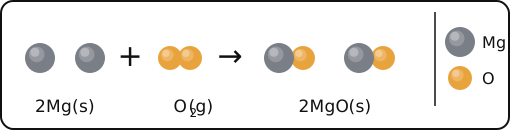
Count the atoms on each side: magnesium 2 and 2, oxygen 2 and 2.
The crucible gets heavier. Oxygen from the air joins the magnesium. It wasn't weighed at the start, so the mass looks as if it has gone up, but no atoms are made. Dalton explained why mass is conserved: atoms are separated and recombined, and the number and type of each atom stays the same.
Stay safe
- Do not look directly at burning magnesium.
- The crucible, lid, pipeclay triangle and tripod stay hot long after they stop glowing: tongs only.
- Never cool the crucible in water.
- Keep the white smoke in the crucible.
- The light from burning magnesium is very bright and can damage your eyes.
- Goggles stay on until everything is cold.
- Tie hair back, wear a lab coat and stand while heating.
- A crucible cooled in water can crack.
Your handout
The practical sheet for one lesson: your predictions, the safety table, Part 1 (burn a small piece), Part 2 (the crucible and the weighing), results, equations, the class results graph, the particle picture and the homework page. 6 pages.
Class results
Sign in with your school account to add your group's results.
Sign in with your school account to open the handout.
Work it out in Google Sheets
Follow the steps. Each picture shows what your sheet should look like.
The pictures use an example. Your numbers will be different, and your last row will be the last row of your own table.
-
Paste the table
Press “Copy the table”, then “Open a new Google Sheet”. Click cell A1 and paste (Ctrl + V, or ⌘ + V on a Mac).
A B C D 1 Group Crucible and lid (g) With magnesium (g) After heating (g) 2 1 30.25 30.37 30.44 3 2 28.91 29.06 29.15 4 3 31.4 31.5 31.56 5 4 29.73 29.91 30.02 -
Name the new columns
Click each cell in turn (E1, F1, G1) and type its heading.
A B C D E F G 1 Group Crucible and lid (g) With magnesium (g) After heating (g) Magnesium (g) Magnesium oxide (g) Change in mass (g) 2 1 30.25 30.37 30.44 3 2 28.91 29.06 29.15 4 3 31.4 31.5 31.56 5 4 29.73 29.91 30.02 -
Type your first formula
Click cell E2. Type =C2-B2 and press Enter. Every formula starts with =.
The mass with magnesium, take away the empty crucible and lid: that leaves the magnesium (B − A on your sheet).
A B C D E F G 1 Group Crucible and lid (g) With magnesium (g) After heating (g) Magnesium (g) Magnesium oxide (g) Change in mass (g) 2 1 30.25 30.37 30.44 =C2-B2 3 2 28.91 29.06 29.15 4 3 31.4 31.5 31.56 5 4 29.73 29.91 30.02 -
Type the other formulae
Do the same in the next cells:
- F2
=D2-B2The mass after heating, take away the empty crucible and lid: that leaves the magnesium oxide (C − A). - G2
=D2-C2The mass after heating, take away the mass before: that is the change in mass (C − B).
A B C D E F G 1 Group Crucible and lid (g) With magnesium (g) After heating (g) Magnesium (g) Magnesium oxide (g) Change in mass (g) 2 1 30.25 30.37 30.44 0.12 0.19 0.07 3 2 28.91 29.06 29.15 4 3 31.4 31.5 31.56 5 4 29.73 29.91 30.02 - F2
-
Fill the formulae down
Select cells E2:G2. Drag the small blue square at the corner down to row 5. The sheet works out every group for you.
A B C D E F G 1 Group Crucible and lid (g) With magnesium (g) After heating (g) Magnesium (g) Magnesium oxide (g) Change in mass (g) 2 1 30.25 30.37 30.44 0.12 0.19 0.07 3 2 28.91 29.06 29.15 0.15 0.24 0.09 4 3 31.4 31.5 31.56 0.1 0.16 0.06 5 4 29.73 29.91 30.02 0.18 0.29 0.11 -
Work out the averages
Click cell E7. Type =AVERAGE(E2:E5) and press Enter. Then do the same under columns F, G.
AVERAGE adds the numbers from row 2 to row 5 and divides by how many there are. If the sheet shows a long decimal, round it to 2 decimal places. If a formula shows an error, check that every number uses a point, not a comma.
A B C D E F G 1 Group Crucible and lid (g) With magnesium (g) After heating (g) Magnesium (g) Magnesium oxide (g) Change in mass (g) 2 1 30.25 30.37 30.44 0.12 0.19 0.07 3 2 28.91 29.06 29.15 0.15 0.24 0.09 4 3 31.4 31.5 31.56 0.1 0.16 0.06 5 4 29.73 29.91 30.02 0.18 0.29 0.11 6 7 Average 0.1375 0.22 0.0825
Try it
Balance the equation for the reaction you did. Count the atoms on each side first.
- Count the atoms on each side. Every big number is 1 for now. Count each kind of atom in the reactants on the left and in the products on the right.
- Balance it with the big numbers. Make the two bars for each element equal. Change only the big numbers in front. The small numbers are locked.
- Mg + O₂ → MgO: Balanced: 2 Mg(s) + O₂(g) → 2 MgO(s)
- Same atoms before and after. Same atoms before and after, so the mass is the same.