Year 9 · Unit 1 · 1.7 · Practical
Lab 3 · The copper cycle: follow the copper atoms
Aim: take copper through three chemical reactions and get copper back at the end, showing that the copper atoms are never made or destroyed.
In your booklet: PDF pp. 49–52 (copper cycle); p. 43–44 (notation); p. 45 (conservation of mass)
The three stages
- Burn.
- Sand a copper plate until it is shiny.
- Hold it in a blue (roaring) Bunsen flame with tongs for 2–3 minutes.
- A black layer of copper oxide forms.
- Scrape and add acid.
- Scrape the copper oxide into a small beaker.
- Add 20 ml of dilute sulphuric acid and warm gently, stirring, until the black solid has gone.
- You get a blue solution of copper sulphate.
- Get the copper back.
- Put a sanded iron nail into the copper sulphate solution for a few minutes.
- Pink-brown copper coats the nail.
Key words
| Word | Meaning |
|---|---|
| reactant / product | what you start with / the new substances made |
| oxidation | a substance joins with oxygen (stage 1) |
| copper oxide, CuO | the black compound made when copper joins with oxygen |
| acid | see "What is an acid?" below |
| sulphuric acid, H₂SO₄(aq) | the acid used in stage 2 |
| salt | the compound made when an acid reacts; here copper sulphate. Sulphuric acid makes sulphates; hydrochloric acid makes chlorides |
| acid–base reaction | an acid reacts with a metal oxide to make a salt and water (stage 2) |
| aqueous (aq) | dissolved in water |
| displacement | a more reactive metal takes the place of a less reactive metal in its compound: iron takes copper's place (stage 3) |
| transition metal | copper and iron are both in the central block of the Periodic Table |
| conservation of mass | atoms are rearranged, not made or destroyed, so the total mass of everything before equals the total after |
What is an acid?
In this unit we use two acids: hydrochloric acid, HCl(aq), and sulphuric acid, H₂SO₄(aq). Both are solutions in water.
An acid is a solution that is corrosive and reacts:
- with reactive metals, to give a salt and hydrogen
- with metal oxides, to give a salt and water (that's stage 2)
- with carbonates, to give a salt, water and carbon dioxide
Acids are corrosive: goggles and lab coat whenever acid is out.
The equations
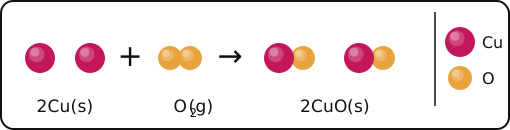
Stage 1: copper + oxygen → copper oxide (oxidation)
2Cu(s) + O₂(g) → 2CuO(s)
Stage 2: copper oxide + sulphuric acid → copper sulphate + water (acid–base)
CuO(s) + H₂SO₄(aq) → CuSO₄(aq) + H₂O(l)
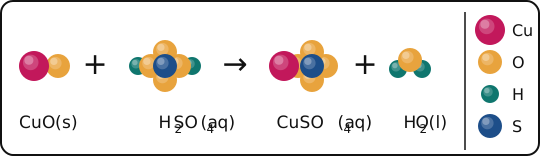
No gas is made: the product is water. Some books wrongly say hydrogen.
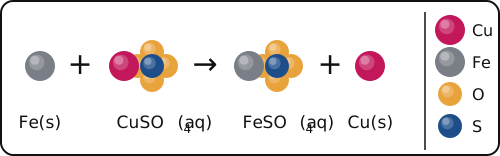
Stage 3: iron + copper sulphate → iron sulphate + copper (displacement)
Fe(s) + CuSO₄(aq) → FeSO₄(aq) + Cu(s)
Follow the copper atoms
| Stage | Where the copper atoms are |
|---|---|
| Start | copper metal (the plate) |
| After stage 1 | copper oxide, on the surface of the plate |
| After stage 2 | copper sulphate, dissolved in the blue solution |
| After stage 3 | copper metal again, coating the nail |
In every equation the number of copper atoms is the same on both sides. The copper goes through three different substances and comes back as copper: conservation of matter. You usually get back less copper than you started with. That isn't because atoms are destroyed: some copper is left behind at each stage, for example oxide that wasn't scraped off.
Stay safe
- Open flame: hair tied back.
- Hot objects: handle with tongs.
- Sulphuric acid: corrosive. Goggles on, and do not let it boil.
- Copper sulphate: harmful.
- Wash your hands at the end.
- Goggles stay on until everything is cleared away.
- Stand while heating. Hot copper looks the same as cold copper.
- Tell your teacher at once about any acid spill.
- Copper routes (the extension): lift the delivery tube out of the limewater before you turn off the Bunsen burner, and keep flames away from the magnesium tube.
Your handout
The practical sheet for the copper cycle, in one lesson. 8 pages.
Want more? Copper routes (3 lessons)
There's an extension: make copper oxide two ways (copper metal and copper carbonate), then get the copper back two ways (iron and magnesium), and compare all four routes. See Copper routes 1–3.
Before Lesson 1, predict: when copper is heated in air, will it get heavier, get lighter or stay the same? And the tube of copper carbonate, which gives off a gas when it is heated?
Watch for and measure
- The colour before, during and after each reaction. Look inside the fold of the copper sheet as well as outside.
- The mass before and after heating: the copper sheet (A1 and A2) and the tube of copper carbonate (B1 and B2).
- What happens to the limewater while the copper carbonate is heated.
- In Lesson 2: which tube gives copper back faster, the iron nail or the magnesium? What forms, and where? Are there bubbles?
- At every stage: which substance are the copper atoms in now?
Lesson 1: Two ways to copper oxide
PDF, 4 pages. Predictions, safety, Way A, Way B, equations and the masses explained.
Lesson 2: Two ways back to copper
PDF, 3 pages. Predictions, safety, copper oxide and sulphuric acid, the iron and magnesium tubes, equations.
Lesson 3: Follow the copper atoms
PDF, 4 pages. Your results, the map of the four routes, the copper atom table, mass and conservation, which route is best.
Try it
Balance the first equation of the cycle: copper heated in air. Count the atoms on each side first.
- Count the atoms on each side. Every big number is 1 for now. Count each kind of atom in the reactants on the left and in the products on the right.
- Balance it with the big numbers. Make the two bars for each element equal. Change only the big numbers in front. The small numbers are locked.
- Cu + O₂ → CuO: Balanced: 2 Cu(s) + O₂(g) → 2 CuO(s)
- Same atoms before and after. Same atoms before and after, so the mass is the same.