Year 9 · Unit 1 · 1.6 · Teacher demonstration
Lab 1 · Alkali metals in water
Aim: watch lithium, sodium and potassium react with water, and use the atom model to explain why the reactions get more violent down group 1.
In your booklet: PDF pp. 32–33
What happens
Your teacher cuts each metal, then drops a small piece into a trough of water behind a safety screen. Universal indicator is added afterwards.
Key words
| Word | Meaning |
|---|---|
| alkali metals | the group 1 metals: lithium, sodium, potassium and the rest of group 1 |
| alkaline | a solution formed when the group 1 hydroxides dissolve; universal indicator turns from green to purple |
| hydroxide | the compound made with hydrogen when a group 1 metal reacts with water, for example lithium hydroxide, LiOH |
| tarnish | go dull in air; the freshly cut metal is shiny |
| exothermic | gives out heat |
| outer electron | the single electron in the outer shell of every group 1 atom; it is lost when the metal reacts |
The equation
lithium(s) + water(l) → lithium hydroxide(aq) + hydrogen(g)
2Li(s) + 2H₂O(l) → 2LiOH(aq) + H₂(g)
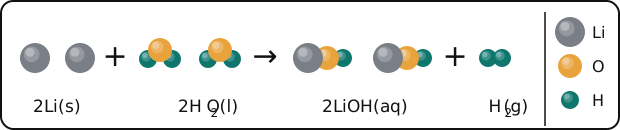
Count the atoms on each side: lithium 2 and 2, oxygen 2 and 2, hydrogen 4 and 4. Nothing is made or destroyed; the atoms are rearranged.
Why the reaction gets more violent down the group
All three atoms have one electron in the outer shell. Going down the group, each atom has one more occupied shell, so the outer electron is further from the nucleus. It is less strongly attracted to the positive nucleus, so it is lost more easily, and the reaction is faster and more violent.
Stay safe
This is a teacher demonstration. Stay behind the line, goggles on. The metals are kept under oil and are never touched. The solution in the trough is alkaline and corrosive.
- Only the teacher handles these metals, and only behind a safety screen.
Your worksheet
The observation sheet for the demo: predictions, what you see, word equations, the pattern, and why it happens. 5 pages.
Videos
Videos of the real reactions. Some show rubidium, which schools do not use.
Try it
Practise what you read above: step down group 1, balance the equation for each metal, then answer one question.
- Lithium (2 shells), sodium (3), potassium (4): the outer electron is further out each time, so it is held less tightly and lost more easily. Reactivity increases down Group 1.
- Fluorine (2 shells), chlorine (3), bromine (4), iodine (5): an incoming electron would sit further out each time, where the pull is weaker, so it is gained less easily. Reactivity decreases down Group 17.
- Count the atoms on each side. Every big number is 1 for now. Count each kind of atom in the reactants on the left and in the products on the right.
- Balance it with the big numbers. Make the two bars for each element equal. Change only the big numbers in front. The small numbers are locked.
- Li + H₂O → LiOH + H₂: Balanced: 2 Li(s) + 2 H₂O(l) → 2 LiOH(aq) + H₂(g)
- Na + H₂O → NaOH + H₂: Balanced: 2 Na(s) + 2 H₂O(l) → 2 NaOH(aq) + H₂(g)
- K + H₂O → KOH + H₂: Balanced: 2 K(s) + 2 H₂O(l) → 2 KOH(aq) + H₂(g)
- Same atoms before and after. Same atoms before and after, so the mass is the same.
Why is potassium more reactive than lithium?
- Both are Group 1, so both have just one outer electron. Look at where that electron sits.
- Check the diagram: potassium has more shells than lithium, so its outer electron is further out, not closer.
- Both are Group 1, so both react by losing their one outer electron.
- In potassium that electron is in a shell further from the nucleus than in lithium.
- So it is held less tightly and lost more easily.
- Easier electron loss = more reactive.
Spot the fake
This clip comes from a British television show, Brainiac: Science Abuse. One part of it was faked. Watch it, then answer the questions before you open the box.
Before you open the box
- Which part do you think was faked? What makes you say so?
- You have seen lithium, sodium and potassium. What would you expect rubidium and caesium to do?
- What would you want to check before you believed the clip? What test could someone do?
Show what really happened
What really happened
- The bath explosions for rubidium and caesium were staged.
- In 2006 a member of the show's team told The Guardian newspaper that almost nothing happened when the caesium went into the bath, so a bomb was put in the bath and set off instead. Source 1
- The chemist Theodore Gray filmed rubidium and caesium in water himself. His explosions were much smaller than the ones in the television clip. Source 2
- In 2008 the television show MythBusters tested it, in the episode “Viewer Special Threequel”. They used 25 g of each metal, more than ten times the amount Brainiac said it used. They got a short flame and some hydrogen gas, and no explosion. Their verdict: busted. Source 3
The MythBusters test
So is the trend wrong?
No. Rubidium and caesium are more reactive than potassium. Their outer electron is even further from the nucleus, so it is lost even more easily.
But more reactive does not have to mean a bigger bang. Theodore Gray explains that the flame and the bang come from the hydrogen burning in air. How big they are depends on how much hydrogen there is and how well it has mixed with the air.
Think about it: how could you check a science video before you trust it?
Where this comes from
- The Guardian, 15 July 2006: Ben Goldacre, “Sky's limit for big bangs”
- Theodore Gray, “Alkali Metal Bangs”
- Wikipedia, “MythBusters (2008 season)”: Alkali Metal Mayhem
Links checked on 5 October 2026.